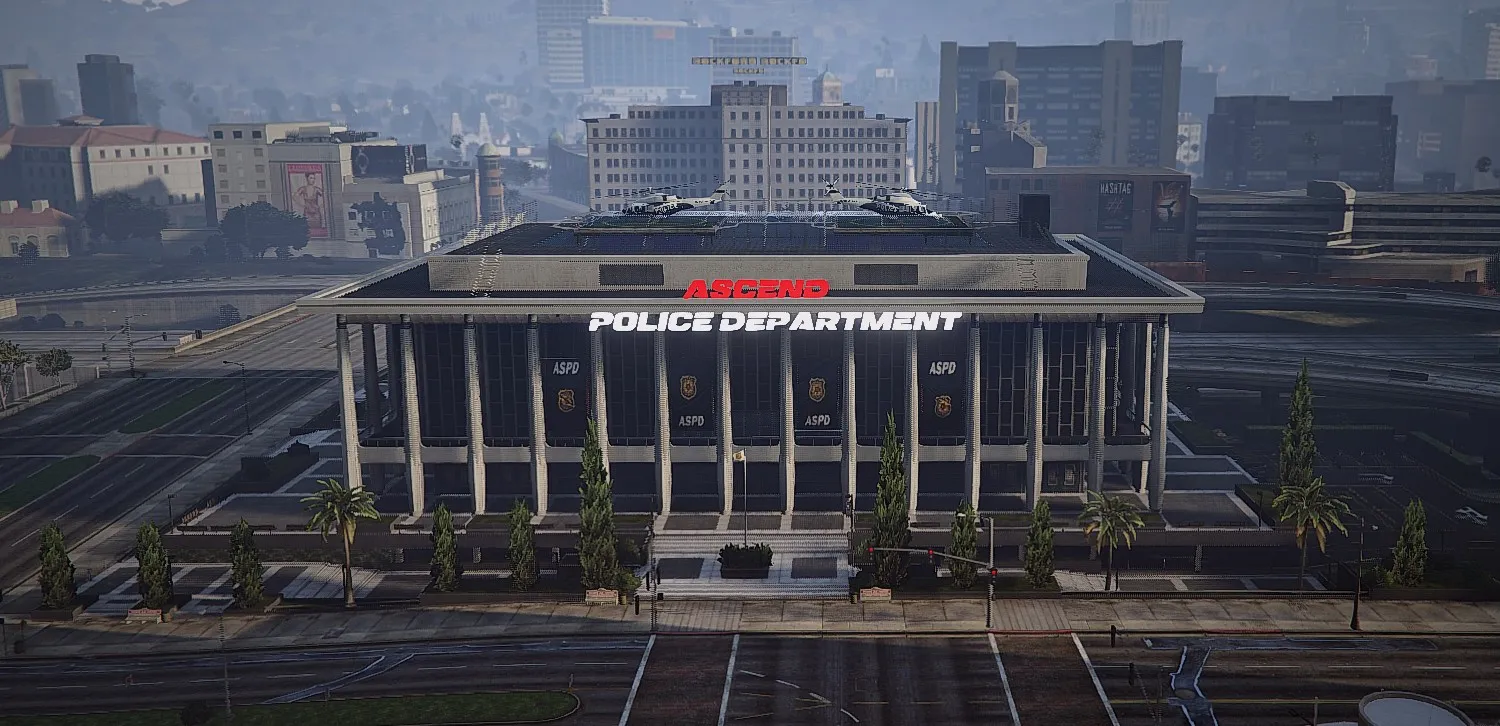
Ascend Police Department
The Ascend Police Department (ASPD) is the primary law enforcement agency of Ascend Roleplay, committed to protecting the city, upholding the law, and ensuring public safety. Rise. Live. Protect.
About ASPD
Who we are and who leads the department.
About ASPD
Rise. Live. Protect.
- The Ascend Police Department (ASPD) is the primary law enforcement agency of Ascend Roleplay, committed to protecting the city, upholding the law, and ensuring public safety.
- ASPD officers serve with professionalism, integrity, discipline, and accountability while delivering realistic, fair, and immersive law enforcement roleplay for the community.
ASPD Leadership
The following officials lead the Ascend Police Department, overseeing departmental operations, strategic planning, intelligence, and law enforcement across Ascend Roleplay.
| Position | Officers |
|---|---|
| CAF – Chief of Armed Forces | T. Vetri Kondan, Nick Fury |
| DIB – Director of the Intelligence Bureau | Antony Durai, Lincoln Clay, Yaazhi BP, Mr Hari |
| DGP – Director General of Police | Reaper Xd, Annamalai Mr, Vinayak Mahadev |
| SDGP – Special Director General of Police | Ashok Kumar, Rama Samy |
| ADGP – Additional Director General of Police | Sibi Chakaravarthi, Thor Odinson, David Martinez |
Rules & Regulations
Standard Operating Procedures (SOP): the procedures every ASPD Officer must follow while on duty.
Basic Definitions
- SuspectA person believed to have committed a crime but not yet proven guilty.
- CriminalA person who has been found guilty or has confessed to committing a crime.
- WarrantA legal authorization allowing officers to arrest an individual or search a property.
- BOLO (Be On the Lookout)A police alert issued for a wanted person, suspect, or related vehicle.
Vehicle Siren Codes & Patrolling
- Lights off
- Siren off
Routine patrol — no lights or sirens.
- Lights on
- Siren off
Priority response — lights only.
- Lights on
- Siren on
Emergency response — lights and sirens.
- Inform the Officer in Charge (OIC) before starting patrol.
- Follow traffic laws unless responding under Code 3.
- Secure your patrol vehicle when unattended.
- Store evidence only in the Police Evidence Vault.
- Police vehicles may only be driven by authorized officers.
- Use sirens only during emergencies or pursuits.
Traffic Stop Procedure
- Initial Stop
- Activate lights and sirens.
- Direct the vehicle to a safe location.
- Prioritize officer safety.
- Communication
- Inform Dispatch.
- Request the driver's Citizen ID and Driver's License.
- Record all vehicle details.
- Investigation
- Explain the reason for the stop.
- Verify identity and ownership.
- Check for Warrants or BOLOs.
- Issue a warning or citation if necessary.
- Limitations
- Vehicle searches require Probable Cause or a valid Warrant.
- Arrests may only be made with sufficient legal grounds.
Terry Stop Procedure
- Before the Stop
- Gather available information.
- Plan a safe approach.
- During the Stop
- Activate lights and sirens.
- Notify Dispatch.
- Request identification.
- Backup
- Coordinate with responding units.
- Secure the surrounding area.
- Suspect Handling
- Give clear commands.
- Assess for threats.
- Conduct a lawful search when justified.
- Arrest only when Probable Cause exists.
- Vehicle Search
- Conduct an inventory search after arrest.
- Search for evidence when legally justified.
- Impound the vehicle after the scenario if required.
Hostage Handling
The following procedures must be followed during any hostage situation to ensure the safety of hostages, officers, and civilians while maintaining professional police operations.
- 1. Hostage Handling Unit AssignmentThe Lead Officer is responsible for assigning a dedicated Hostage Handler based on the officer's experience, training, and ability to manage high-pressure negotiations.
- 2. Establishing a PerimeterA secure perimeter must be established around the robbery location.
- Deploy spike strips where necessary to prevent the suspect vehicle from escaping.
- Position police units strategically to secure the surrounding area while maintaining public safety.
- 3. Negotiation — Direct CommunicationAll negotiations should be conducted face-to-face whenever possible. This allows officers to assess the robbers' behaviour, body language, and overall intentions.
- 3. Negotiation — Cover & ConcealmentThe Hostage Handler should always negotiate from a position that provides adequate cover, such as behind a police vehicle or other suitable protection.
- 3. Negotiation — Assessing DemandsCarefully listen to the robbers' demands and evaluate whether any reasonable compromises or concessions can be made without compromising officer or public safety.
- 3. Observation & Evidence GatheringWhile negotiating, discreetly observe and gather information. Officers should avoid making these observations obvious to the suspects.
- Suspect appearance
- Clothing description
- Weapons carried
- Vehicle description
- Any other useful identifying information
- 4. Radio UpdatesProvide regular updates to the Lead Officer over the designated radio channel regarding:
- Current situation
- Suspects' demands
- Any significant developments
- 4. Follow InstructionsAll officers involved must follow the directions of the Lead Officer throughout the incident.
- 4. Hostage ReleaseOnce authorised by the Lead Officer, instruct the suspects to safely release the hostage before allowing them to leave as per the agreed negotiation.
Robbery Scenario Rules
These procedures apply to all robbery scenarios involving ASPD units.
- 1. Lead Officer ResponsibilityThe Lead Officer is responsible for managing the entire robbery scenario, coordinating all responding units, assigning responsibilities, and ensuring all departmental procedures are followed correctly.
- 2. Unit AllocationThe highest-ranking available officer will appoint a Lead Officer for the scenario. The Lead Officer will then assign officers based on operational requirements.
- 3. Team CompositionResponse teams should consist of officers from different ranks and experience levels to ensure balanced decision-making and effective operational support.
- 4. Radio CommunicationAll responding officers must immediately switch to the designated radio frequency. The Lead Officer is responsible for announcing the operational radio channel (e.g., ) and ensuring every responding unit joins the correct frequency.
Scenario Procedures
- Initial ResponseThe first responding unit should:
- Secure the scene.
- Assess the situation.
- Relay all initial findings over the radio to responding units.
- Situation AssessmentOnce sufficient units have arrived, a designated officer should gather and relay the following information. It should be communicated clearly to the Lead Officer and all responding units before further action is taken.
- Number of suspects
- Vehicle description
- Weapons observed
- Possible escape routes or plans
- Any additional information relevant to the ongoing scenario
Incident Report
The Lead Officer must assign one officer to maintain and update the Incident Report throughout the scenario.
- The report must include
- Robbery Name
- Robbery Location
- Lead Officer
- Units Involved
- Radio Frequency
- Hostage Handling Officer
- Suspect Vehicle Description
- Weapon(s) Used
- Vehicle Registration Number (If Visible)
Example: 10-90 | Store (Strawberry Ave) | Lead Officer: A. Roy | Units: Vinayak, Reaper, Annamalai | Vehicle & Colour & Plate (If Visible): Burrito, Black, CRP 000 | Weapon: Pistol | Robber Count: 4 | Hostage & Status: Positive/Negative & Good/Critical | Radio Frequency: 1.2 MHz
Chase Procedure & Shootout Protocol
- Chase ProcedureA proper chase formation must be established before the pursuit begins.
- Follow the Lead Officer's instructions at all times.
- Maintain the assigned chase formation regardless of rank or vehicle type.
- Do not alter the pursuit strategy without approval from the Lead Officer.
- Shootout Protocol
- Officers must not initiate a shootout or exit their vehicles unless instructed by the Lead Officer.
- Firearms should only be used when legally justified and properly authorized.
Apprehension, Jail Processing & Evidence
- Suspect ApprehensionIf suspects become unconscious:
- Transport them to the Medical Bay for treatment.
- A minimum of two officers must accompany the suspect.
- During revival, one officer must maintain security using a taser until the suspect is secured.
- Jail ProcessingThe Lead Officer is responsible for overseeing the complete jail processing procedure, including:
- Informing suspects of their charges.
- Explaining their legal rights.
- Issuing the appropriate jail sentence.
- Evidence HandlingOnce suspects have been incarcerated:
- Deposit all confiscated items into the Police Evidence Locker.
- Record every confiscated item in the Confiscate-Logs section.
Scenario Report & Conclusion
- Scenario ReportAfter every completed scenario, the Lead Officer must submit a detailed report including:
- Scenario Name
- Officers Involved
- Operational Outcome
- Officer Performance
- Final Status
Example: 10-90 | Store (Strawberry Ave) | Lead Officer: A. Roy | Units: Vinayak, Reaper, Annamalai | Status (Codes Only): 10-75 & 10-100 or 10-74 & 10-100 | Suspects Arrested: 2 / Nil
- Scenario ConclusionOnce all required procedures have been completed, the Lead Officer may officially conclude the operation by announcing 10-100.
Disciplinary Actions
Failure to follow departmental procedures may result in a Warning, Suspension, Demotion, or Termination, depending on the severity of the violation.
- Disobeying Lead Officer CommandsAny officer who disregards the Lead Officer's instructions or attempts to take control of a scenario without authorization will face disciplinary action.
- Professional ConductOfficers must remain respectful and professional when dealing with suspects, civilians, and fellow officers.
- SOP ComplianceAll officers are expected to follow departmental Standard Operating Procedures during every scenario.
- Chase DisciplineIgnoring the assigned chase formation or intentionally rushing a scenario may result in disciplinary action.
- Suspect ProcessingOfficers must complete suspect processing before responding to unrelated activities.
- Lead Officer AccountabilitySerious operational mistakes made by the Lead Officer will be reviewed by the Head of Department.
- Repeat Offences
- First Offence — Warning
- Repeated Offences — Suspension, Demotion, or Termination.
Police Jail Sentences
- Jail TimingsOnly the Lead Officer is authorized to determine jail sentences.
- No Sentence ReductionProcessing delays are not a valid reason to reduce jail time.
- Equal TreatmentAll suspects must be treated equally, regardless of personal relationships.
- Streamer EqualityStreamers are not entitled to special treatment. Violations may result in immediate suspension or demotion.
Driving Without a License
Offence: operating a vehicle without a valid driver's license.
- Consequences
- Vehicle will be impounded.
- Appropriate fine will be issued.
- Driver must enrol in Driving School.
- A criminal record will be registered.
- Repeat OffendersThe vehicle will only be released after:
- The required fine has been paid.
- A valid driver's license has been presented.
Complaint Handling & Disciplinary Action
- Complaint InvestigationAll IC and OOC complaints against officers will be investigated promptly.
- Disciplinary MeasuresDepending on the severity of the offence, disciplinary action may include:
- Warning
- Suspension
- Demotion
- Termination
- TransparencyAll disciplinary actions will be documented and communicated to the affected officer to ensure fairness, professionalism, and accountability.
Chain of Command
Every ASPD rank, from Trainee to Chief of Armed Forces.
ASPD Ranks
| Grade | Code | Rank | Category |
|---|---|---|---|
| 24 | CAF | Chief of Armed Forces | Head of Police |
| 23 | DIB | Director of the Intelligence Bureau | Head of Police |
| 22 | DGP | Director General of Police | Head of Police |
| 21 | SDGP | Special Director General of Police | Head of Police |
| 20 | ADGP | Additional Director General of Police | Head of Police |
| 19 | IG | Inspector General of Police | High Command of Police |
| 18 | ADIG | Additional Inspector General of Police | High Command of Police |
| 17 | DIG | Deputy Inspector General of Police | High Command of Police |
| 16 | AIG | Assistant Inspector General of Police | High Command of Police |
| 15 | SP | Superintendent of Police | Commander of Police |
| 14 | ADSP | Additional Superintendent of Police | Commander of Police |
| 13 | DSP | Deputy Superintendent of Police | Commander of Police |
| 12 | ASP | Assistant Superintendent of Police | Commander of Police |
| 11 | COM | Commissioner of Police | Supervisor of Police |
| 10 | ADCP | Additional Commissioner of Police | Supervisor of Police |
| 9 | DCP | Deputy Commissioner of Police | Supervisor of Police |
| 8 | ACP | Assistant Commissioner of Police | Supervisor of Police |
| 7 | INS | Inspector of Police | Enlisted Police |
| 6 | AI | Assistant Inspector | Enlisted Police |
| 5 | SI | Sub Inspector | Enlisted Police |
| 4 | ASI | Assistant Sub Inspector | Enlisted Police |
| 3 | HC | Head Constable | Enlisted Police |
| 2 | SC | Senior Constable | Enlisted Police |
| 1 | CONS | Constable | Enlisted Police |
| 0 | TR | Trainee | Probation |
Radio Codes
The 10-codes every ASPD officer uses on the radio.
ASPD Radio Codes
| Code | Meaning |
|---|---|
| 10-2 | Arrived on Scene |
| 10-3 | On the Way |
| 10-4 | Copy That / Acknowledged |
| 10-5 | Short Break |
| 10-6 | Back from Short Break |
| 10-7 | Off Duty |
| 10-8 | On Duty |
| 10-9 | Repeat the Message |
| 10-10 | Fight in Progress |
| 10-20 | Current Location / Shot Location |
| 10-21 | Call by Phone |
| 10-30 | PD Under Attack |
| 10-31 | Car Hijacking |
| 10-32 | Man with Gun / Shots Fired |
| 10-33 | Medical Emergency Requested |
| 10-34 | On Traffic Stop |
| 10-40 | Vehicle Pursuit in Progress |
| 10-50 | Request Backup |
| 10-65 | Missing Person |
| 10-66 | Suspicious Person |
| 10-74 | Negative |
| 10-75 | Positive |
| 10-80 | Vector – Vehicle Pursuit / Foxtrot – Foot Pursuit |
| 10-90 | Robbery in Progress |
| 10-100 | Situation Clear |
Application Guide
What to do before applying to join ASPD.
ASPD Application Guide
We value integrity, professionalism, discipline, and dedication. Good luck, and we look forward to welcoming you to ASPD!
- Read all ASPD Rules & Guidelines.
- Fill out the application honestly and completely.
- Provide accurate information about your law enforcement experience.
- Apply as a Fresher if you're unsure of your experience.
- False or unverifiable information may result in your application being processed as a Fresher or rejected.
Rise. Live. Protect. — Fair policing makes the best stories for everyone in the city.
Frequently asked questions
Quick answers about the aspd rules. Still unsure? Open a ticket and staff will help.

Start your story in Ascend
Join our Discord and read the rules before you jump in.